



If a man takes birth control—especially one pill by accident—the most common outcome is… not much. Maybe mild nausea, a headache, or feeling a little “off,” and then life goes on.
But (and it’s a real “but”), the answer changes depending on what type of birth control it was, how much was taken, and whether it was a one-time thing or repeated.
Accidental single dose vs. repeated use
Think of hormones like seasoning. A pinch once probably won’t change the whole meal. But dumping the entire shaker in every day? Different story.
A single birth control pill in an adult male usually causes minimal, short-lived side effects. Taking hormonal birth control regularly, however, could lead to noticeable hormone-related changes over time.
Why “birth control” isn’t one single thing
“Birth control” is an umbrella term. It can mean:
- daily pills with estrogen + progestin
- progestin-only pills
- emergency contraception (like Plan B)
- patches, rings, injections, implants, and hormonal IUDs (not swallowed, but still hormones)
So when someone asks, “What happens if a man takes birth control?” the real question is: which one, how much, and how often?
What Counts as “Birth Control” in This Context?
Let’s break down what people usually mean when they say “birth control.”
Combined oral contraceptive pills (estrogen + progestin)
These are the classic “the pill” birth control options. They contain:
- Ethinyl estradiol (an estrogen) in many formulations
- A progestin (there are several types)
This combo is the one with the most discussion around side effects and clot risk (mostly related to estrogen).
Progestin-only pills (mini-pill)
The mini-pill doesn’t contain estrogen—only a progestin. It’s often prescribed when estrogen isn’t a good fit for someone.
If a man took one of these, it’s also typically a low-drama situation, especially as a one-off.
Emergency contraception pills (Plan B and similar)
Emergency contraception (EC) like Plan B typically contains levonorgestrel, a progestin-like hormone, in a higher dose than daily pills.
People sometimes worry EC is “super strong.” It is stronger than a daily pill dose, but in a male body, it still usually leads to temporary, mild effects at most.
Hormonal patches, rings, shots, implants, and IUDs
These exist, but they’re less relevant to “a man takes it” because they aren’t typically swallowed.
Why most of these aren’t “one-time swallow” situations
A patch, ring, implant, or IUD delivers hormones over time. If you’re talking about a man “taking” birth control, you’re almost always talking about pills.
Non-hormonal contraception (copper IUD, condoms, etc.)
If a man uses a condom, nothing hormonal happens. If he somehow swallowed a non-hormonal method (not realistic), there’s no hormone effect to discuss.
So for the rest of this article, we’re mainly talking about hormonal birth control pills and emergency contraception.
Read more about Hydrocelectomy: Recovery, Causes, Procedure, and Risks
Hormones 101: What These Pills Are Trying to Do
How birth control prevents pregnancy in women
In women, many birth control pills work mainly by:
- preventing ovulation (no egg released)
- thickening cervical mucus (harder for sperm to travel)
- changing the uterine lining (less friendly for implantation)
It’s like putting multiple locks on a door.
Why does that mechanism not “translate” to men
A man’s reproductive system is built differently. There’s no ovulation to stop, no cervix, no uterine lining. So the main “targets” of the pill don’t exist.
No ovaries, no ovulation, no target
That’s why birth control pills aren’t a “male contraceptive hack.” They’re designed for the female reproductive system.
What hormones can still affect the male body?
Even though the pill can’t do its main job in a man, the hormones can still interact with the body’s broader hormone network, affecting things like:
- fluid balance
- mood
- libido
- breast tissue sensitivity
- (with long-term exposure) hormone signaling
So the pill isn’t “nothing.” It’s just usually not dramatic, especially in the short run.
What Happens If a Man Takes a Birth Control Pill Once?
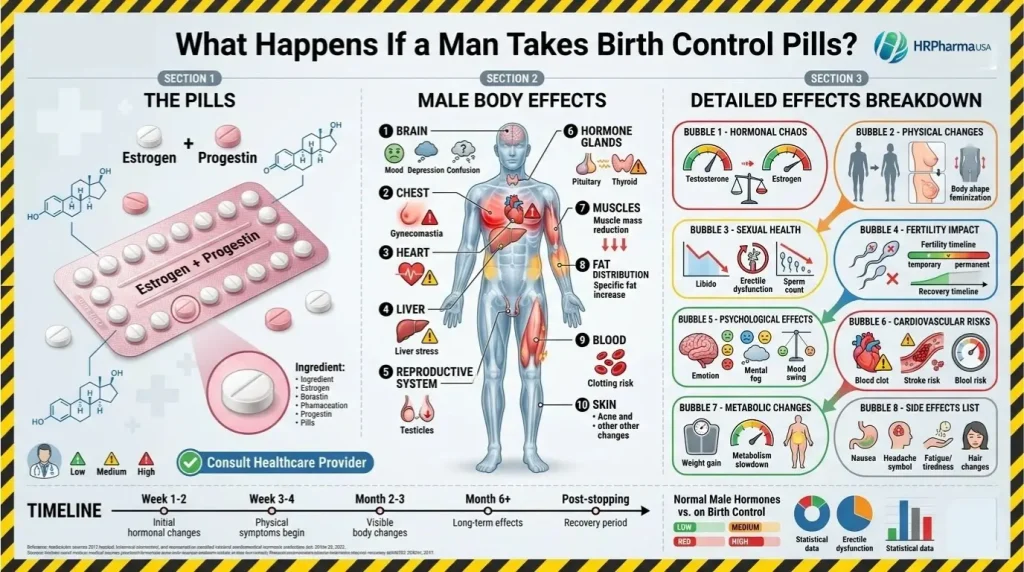
Here’s the scenario most people mean: an adult man accidentally takes one of his partner’s pills, or takes it as a joke (not recommended), or mixes up medications.
Common short-term effects
A single dose usually causes either no symptoms or mild symptoms that fade within a day or so.
Nausea and stomach upset.
This is probably the most common complaint. Hormones can irritate the stomach or trigger mild nausea—similar to how some people feel carsick: not dangerous, just unpleasant.
Headache and fatigue
A hormone dose can sometimes cause a temporary headache or make you feel sluggish, like you slept fine, but your brain didn’t get the memo.
Mood changes
Some people feel irritable or emotionally “tilted.” Not everyone, and not always—just possible.
Breast tenderness or water retention
Usually, this is more of a repeated-use effect, but some people are sensitive and may feel slightly bloated or tender.
What usually does NOT happen
Let’s shut down the internet panic headlines.
No instant feminisation
One pill will not suddenly reshape your body, change your voice, or cause instant breast growth. Bodies don’t remodel themselves overnight because of one tablet.
No permanent hormone shift from one pill
Your body’s hormone system is more like a thermostat than a light switch. One small blip doesn’t permanently reset it.
No effect on the ability to get someone pregnant
Taking a birth control pill does not make a man temporarily sterile. It’s not “contraception for men,” and it won’t reliably reduce sperm production from a one-time dose.
What If a Man Takes Birth Control Repeatedly?

Now we’re in a different territory. If a man takes hormonal birth control daily for weeks or months, he’s introducing ongoing exposure to hormones that aren’t intended for male contraception at typical pill doses.
Could changes happen? Yes. Are they predictable? Not perfectly.
Potential hormone-related changes over time
Long-term exposure to estrogen and/or progestins can affect the hypothalamic-pituitary-gonadal (HPG) axis—the system that regulates testosterone and sperm production.
Libido and sexual function
Some men might notice:
- lower libido
- changes in erection quality
- changes in mood that affect sexual interest
But responses vary. Hormones and sexuality are like a soundboard—move one slider and the whole mix can change differently for different people.
Body composition and water weight
Estrogen can influence water retention and fat distribution in some contexts. Over time, some men might feel:
- more bloated
- slight weight fluctuations
- changes in how the body “holds” water
This isn’t guaranteed, and it’s not typically dramatic unless hormone exposure is substantial or prolonged.
Breast tissue changes
Extended exposure to estrogenic effects may increase the chance of gynecomastia (breast tissue enlargement) or tenderness in some men.
This is one of the more common worries, and it’s not totally imaginary—just more likely with ongoing hormone influence rather than a one-time mistake.
Fertility and sperm: what could change
Testosterone signalling and sperm production basics
Sperm production is driven by signals from the brain (LH/FSH) to the testes. When external hormones alter the feedback loops, the body may reduce those signals.
Could it lower sperm count?
With enough hormonal influence and time, it’s possible for sperm parameters to change. But here’s the key point: standard women’s birth control pills are not designed or dosed as male contraception, so using them for that purpose is unreliable and potentially risky.
Also, any potential suppression would not be something to “try at home.” If someone wants hormone-based contraception, the right answer is: it should be specifically designed, prescribed, and monitored for that purpose.
Mental health and mood considerations
Hormones can affect neurotransmitters and stress responses. Some people report mood swings, anxiety, or low mood on hormonal contraceptives (in female users), and similar effects could theoretically show up in men with repeated exposure.
If mood changes appear, that’s not something to tough out in silence. It’s a sign the body isn’t loving what’s happening.
Skin and hair: acne, oiliness, and hair changes
Because androgens (like testosterone) influence acne and hair patterns, anything that shifts androgen signalling could change:
- acne severity
- skin oiliness
- hair shedding patterns
Again, this is more relevant to repeated exposure, not one accidental pill.
Also read about Phentolamine for ED: How it's Works, Uses, Benefits, and Side Effects
Side Effects and Risks Men Should Know About
Even though many men will feel little to nothing from a single pill, it’s still smart to understand potential risks—especially if multiple pills are taken or if there are underlying medical issues.
Blood clot risk (the estrogen issue)
Estrogen-containing birth control is known to increase clot risk in some users (in women). For men, we don’t treat birth control pills as a normal medication, so the risk profile isn’t the same “standard use” scenario.
Still, estrogen exposure is the main reason people raise an eyebrow.
Who is at higher risk?
Clot risk tends to be higher in people with factors like:
- smoking (especially heavier smoking)
- personal or family history of clots
- certain clotting disorders
- prolonged immobility
- obesity
- older age
A single pill is unlikely to trigger a major event in a healthy person, but taking many pills or repeated exposure—especially in a higher-risk individual—is a different conversation.
Why dose and duration matter
Just like sun exposure: one short walk outside isn’t the same as lying on the beach every day without sunscreen. Duration changes the math.
Blood pressure and cardiovascular considerations
Hormones can affect fluid retention and vascular tone. If someone already has blood pressure issues, hormone exposure may complicate things.
Liver and gallbladder considerations
Oral hormones are processed in the body and can affect liver metabolism in susceptible people, especially with long-term use.
Medication interactions
Smoking, certain meds, and other risk multipliers
Some medications and habits can increase risk. If someone accidentally took a pill, it’s usually no big deal. If someone is taking hormonal contraceptives repeatedly while also smoking or using certain meds, that’s not a casual situation anymore.
What Happens If a Man Takes Emergency Contraception (Plan B)?
This is a common specific question, so let’s handle it clearly.
What Plan B contains and what it does
Plan B typically contains levonorgestrel, a progestin-like hormone. In women, it mainly works by delaying ovulation.
Likely effects in men
Usually minimal
If a man takes Plan B, it generally doesn’t have a meaningful “target” mechanism, so most men won’t notice much beyond possible side effects.
Possible nausea, headache, fatigue
Because it’s a higher hormone dose, mild side effects like nausea, headache, dizziness, or fatigue are possible. Usually temporary.
What it will not do
It won’t “undo” sex or prevent pregnancy from the male side.
Plan B is not a “male emergency contraceptive.” A man taking it does not reduce the chance of pregnancy from sex that has already happened. The pregnancy risk is determined by whether sperm met an egg and what the female partner’s cycle timing was, not by the male partner swallowing levonorgestrel afterwards.
Can Men Use Birth Control Pills as “Male Birth Control”?
Why doesn’t it work that way?
It’s tempting to think: “If it prevents pregnancy for women, maybe it prevents pregnancy for men too.” But the biology doesn’t line up.
Women’s birth control pills are built to stop ovulation and change cervical mucus. Men don’t ovulate, and men don’t have cervixes. Taking the pill doesn’t reliably suppress sperm production in a controlled, safe, predictable way—especially not at standard doses.
What male hormonal contraception research actually looks like
Male contraception research has explored hormone combinations that suppress sperm production by altering LH/FSH signalling—usually involving androgens plus progestins in carefully selected doses.
Testosterone + progestin approaches
These approaches aim to keep testosterone levels adequate for well-being while suppressing sperm production via feedback loops. That’s very different from borrowing someone else’s birth control pack.
Why is dosing different from women’s pills
The dose, delivery method, and monitoring are different because the goal is different: suppress sperm production while maintaining male health markers. Women’s pills aren’t designed to do that job.
Special Situations People Confuse With This Topic
Transgender hormone therapy isn’t “taking birth control”
Some people mix these up. Transfeminine hormone therapy may include estrogen and androgen blockers, but it’s not the same as taking birth control, and it’s done with medical monitoring for a completely different purpose.
Gynecomastia treatments vs. causing gynecomastia
People worry that birth control pills could cause breast changes in men (mostly with long-term exposure). That’s a separate topic from treatments used to manage gynecomastia or hormone imbalances.
Accidental ingestion by kids or pets: what to do
If a child takes multiple pills or you’re unsure what happened, treat it like any accidental medication ingestion: don’t panic, but don’t shrug it off either—get guidance quickly.
What To Do If a Man Takes Birth Control
If it were one pill
Most of the time:
- Monitor for mild side effects (nausea, headache)
- Drink water, eat normally if you can
- avoid doubling down (don’t take more)
- If you have medical conditions or take other meds, it may be smart to call a pharmacist or clinician for reassurance.
If it were multiple pills or a child took them.
This is where you should escalate.
When to call Poison Control or seek urgent care
Call Poison Control (in the U.S., 1-800-222-1222) or your local equivalent if:
- Multiple pills were taken.
- A child took it
- You don’t know how many were taken.
- Symptoms are concerning
Symptoms that deserve immediate attention
Seek urgent evaluation for symptoms like:
- chest pain, shortness of breath
- severe headache, vision changes
- severe leg swelling/pain (especially one-sided)
- fainting, severe dizziness
- severe allergic reaction signs (rare)
These aren’t “expected” effects, but they’re important to recognise.
Read more about How to Be More Sexually Active in a Healthy Way
Myths vs. Reality
Myth: “One pill will change my body”
Reality: One pill is usually a minor blip, not a makeover.
Myth: “It will make me infertile permanently”
Reality: Permanent infertility from accidentally taking birth control is not a typical concern. Long-term hormone manipulation is complex, but accidental exposure isn’t the same as sustained therapy.
Myth: “It’s basically steroids in reverse”
Reality: Hormones aren’t superhero potions. They’re signals. And the body is good at buffering short-term noise.
Reality: Hormones can matter, but context is everything
How much? How often? Which formulation? What’s your baseline health? Context is the whole game here.
Better Birth Control Options for Men
If the real question behind “what happens if a man takes birth control?” is “What can men do for contraception?”—there are solid, proven options.
Conceptive Pills
- Yaz (Drospirenone/Ethinylestradiol)
- Dronis (Drospirenone/Ethinyl Estradiol)
- Yasmin (Drospirenone/Ethinylestradiol)
- Progynova 2 mg (Estradiol)
- Novelon Tablet (Ethinyl Estradiol / Desogestrel)
- Ovral L Tablet (Ethinyl Estradiol/Levonorgestrel)
- Progynova (Estradiol)
- Progynova 1 mg (Estradiol)
- Dronis 20 mg (Drospirenone/Ethinyl Estradiol)
- Dronis 30 mg (Drospirenone/Ethinyl Estradiol)
- Femovan (Ethinyl Estradiol/Gestodene)
- Logynon (Tri-Phasic Combined Oral Contraceptive)
- Cilique (Oral Contraceptive)
- Crisanta (Ethinylestradiol/Drospirenone)
- Crisanta LS (Ethinylestradiol/Drospirenone)
Condoms
Condoms are reliable when used correctly, protect against STIs, and don’t mess with hormones. They’re the multitool of contraception.
Vasectomy
For people who are done having kids (or don’t want them), a vasectomy is a highly effective, long-term option. It’s not “casual,” but it is common and generally straightforward.
Shared contraception planning
How to talk about it without awkwardness
A simple script works:
“What are we using? What’s the backup plan if something goes wrong? Do we both feel good about it?”
Birth control is a team sport. Nobody should be guessing.
Conclusion
If a man takes birth control once, the most likely outcome is mild, temporary side effects—or no effects at all. Birth control pills are built to prevent pregnancy in women by stopping ovulation and changing reproductive conditions that men don’t have, so a man taking them won’t suddenly become “protected,” sterile, or feminised overnight.
The situation becomes more serious when pills are taken repeatedly or in large amounts, where hormone exposure could cause unwanted changes and increase risks (especially with estrogen-containing pills).
If ingestion was accidental and minor, it’s usually not an emergency; if it involved multiple pills, a child, or concerning symptoms, getting prompt professional guidance is the smart move.
FAQs
What happens if a man takes Plan B (emergency contraception)?
Usually, there are not many possible temporary side effects, such as nausea or headache. Plan B won’t prevent pregnancy when taken by a man after sex, because it works by delaying ovulation in the person who could become pregnant.
Will birth control pills lower a man’s testosterone?
A single pill is very unlikely to cause a noticeable testosterone change. Repeated exposure over time could affect hormone signalling in some cases, but it’s not a safe or reliable method for anything, and it shouldn’t be used that way.
Can a man get sick from taking one birth control pill?
Most men won’t get seriously sick from one pill. If anything happens, it’s usually mild nausea, a headache, or fatigue that fades within a day. If symptoms are severe or you have underlying health risks, contact a healthcare professional.
What should I do if my child swallowed birth control pills?
Call Poison Control (or your local poison advice service) right away for tailored guidance, especially if you don’t know how many pills were taken. Most cases are manageable, but you want the correct next steps based on age, weight, and the specific product.
Can a man use a woman’s birth control pills to avoid getting someone pregnant?
No. Women’s birth control pills are not as effective as male birth control. They don’t reliably stop sperm production, and using them that way can create unnecessary health risks.