


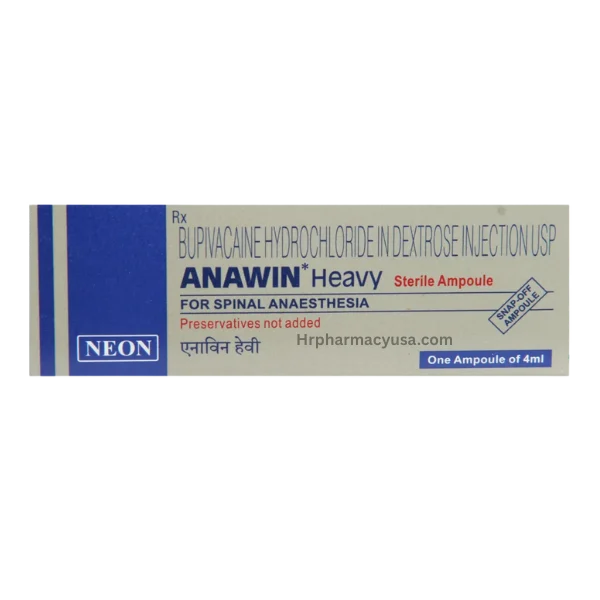
Anawin Heavy 5 Mg Inj. (Bupivacaine)
Price range: $30.00 through $85.00
Anawin Heavy 5 mg Inj. (Bupivacaine) is a local anesthetic used for pain relief during surgeries or medical procedures. It works by blocking nerve signals, providing effective numbing in the targeted area.
| Active Ingredient | Bupivacaine |
|---|---|
| Manufacturer | Neon Laboratories |
| Packaging | 5mg in inj. |
| Strength | 5mg |
| Delivery Time | 6 To 15 days |
In Stock
Anawin Heavy 5 mg Injection (Bupivacaine 0.5 % Heavy) – The Down-to-Earth Product Low-Down
Fast Facts at a Glance
| Item | Details |
|---|---|
| Brand name | Anawin Heavy |
| Generic | Bupivacaine Hydrochloride (0.5 % w/v) in 8 % dextrose |
| Strength on label | 5 mg per mL (hence the “5 mg Inj.”) |
| Form | Clear, colourless, single-use glass ampoule, 4 mL & 20 mL packs (check local stock) |
| Baricity | Hyperbaric—heavier than CSF, so it sinks in the intrathecal space |
| Primary use | Single-shot spinal (sub-arachnoid) anaesthesia for surgeries below the umbilicus |
| Maker | (Usually) Neon / Synergia Life Sciences, distribution can vary |
What Makes Anawin “Heavy”?
Regular (“plain”) bupivacaine is isobaric, meaning it roughly floats at the same level as spinal fluid. Anawin Heavy, however, is mixed with about 80 mg of dextrose per millilitre. That extra sugar ups the density, so once you inject it into the lumbar intrathecal space it literally sinks under gravity. Why that matters:- Predictable spread – Let the patient lie flat, you get a nice lower-body block. Tip the table head-down or head-up, and you can deliberately steer the block.
- Rapid onset – Hyperbaric solutions hit the nerve roots faster, which means the knife can go in sooner.
- Less drug, more punch – Because the block is dense where you want it, you can often use a slightly smaller total dose than with plain solutions.
How It Works (Minus the Lecture)
Pain signals zip up nerves using sodium channels. Bupivacaine parks itself in those channels and keeps them shut, so the signal never reaches the brain. Muscles go floppy, pain vanishes—job done. The “heavy” part doesn’t change the basic science, it just changes where gravity parks the medicine.Typical Operating-Room Uses
- Lower-limb orthopaedics: Knee replacement, tibial plating, ankle work.
- Urology: TURP, bladder tumour resection, ureteric stone surgery.
- Obstetrics & gynaecology: Elective C-section (depends on local policy—some prefer plain or with fentanyl), vaginal hysterectomy.
- General surgery below the navel: Hernia repair, appendectomy, piles surgery.
- Plastic & reconstructive: Skin grafting, varicose-vein stripping in the leg.
Step-by-Step, Real-World Dosing Guide*
(Always follow your hospital protocol and patient factors—this is the everyday starting point, not carved in stone.)| Patient Category | Typical Dose (0.5 % Heavy) | Spread Achieved |
|---|---|---|
| Average adult (60–80 kg) | 2.5–3 mL (12.5–15 mg) | T4–T6 to S5 in supine & slight head-down |
| Smaller adult / elderly | 2.0 mL (10 mg) | T6–T8 to S5 |
| Caesarean section | 1.8–2.2 mL (9–11 mg) + optional opioid | T4–T6 to S5 |
| Tall / very muscular | Up to 3.5 mL (17.5 mg) | T4–T6 to S5 |
- Use a 25 or 26 G Quincke or pencil-point needle for fewer post-dural headaches.
- Aim for L3-L4 or L4-L5 interspace.
- Slow push over 10–15 seconds; sudden squirt can create bizarre swirls and unpredictable patches.
- The second you withdraw the needle, position the table exactly how you want the block to spread and leave it, at least for the first 5–7 minutes.
How Long Does the Block Last?
| Sensory block | 2–2.5 hours (pain-free time) | | Motor block | 2–3 hours (can’t move legs) | | First pain twinge | Usually 150–180 minutes | | Full recovery | Up to 4–6 hours total | Plan your post-op analgesia accordingly—don’t wait for the patient to start wincing.Why Anaesthetists Like It (Pros)
- Reliable saddle & lower-abdomen cover – Dextrose makes the level easy to predict.
- Economical – No pump, no infusion set, one ampoule usually covers one patient.
- Clear surgical field – Lower blood pressure in spinal anaesthesia means less oozing for many operations.
- Less PONV – Patients often puke less than with volatile-gas GA.
- Spontaneous breathing intact – Great for COPD patients unable to tolerate intubation.
Watch-Outs (Cons & Caveats)
- Sudden high spinal – Tip the table too steep or give too big a dose and you can sail into T2 or higher. Patient can’t breathe, blood pressure crashes. Always keep vasopressors and airway kit within arm’s reach.
- Hypotension / bradycardia – Pre-load with 500–1000 mL crystalloid and have phenylephrine or ephedrine handy.
- Post-dural puncture headache – Rare with fine needles but not zero. Tell patients to report any post-op pounding head that eases when lying flat.
- Urinary retention – Foley catheter is routine in long cases, especially men with prostate issues.
- Allergy / LAST (Local Anaesthetic Systemic Toxicity) – Incredibly rare with spinal doses, but if it happens, standard lipid-emulsion rescue applies.
Who Should Skip or Get a Different Plan?
- Absolute no-nos: Patient refusal, infection at puncture site, uncorrected severe hypovolaemia, frank coagulopathy, raised intracranial pressure, severe aortic stenosis.
- Relative caution: Very elderly with aortic stenosis, uncontrolled hypertension (they crash then overshoot), deformity of the spine, sepsis, known severe allergy to amide anaesthetics.
- Pregnancy > first trimester – perfectly common for C-section, but dose-titrate; nerves are more sensitive.
Side-Effects Cheat-Sheet
| Common | Less Common | Very Rare / Serious |
|---|---|---|
| Low BP, dizziness | Shivering | High spinal with apnea |
| Slow heart rate | Nausea | Cardiac arrest (needs lipid + CPR) |
| Itchy back (if opioid added) | PDPH | Cauda equina or neuro damage* |
Storage & Handling Notes
- Temperature: 15–25 °C; don’t freeze—ice crystals wreck potency.
- Light: Normal OT lighting is fine; just avoid direct sun in a windowsill.
- Single-use: Chuck any leftover; no multi-dose “saving for later”—preservative-free formula.
- Check clarity: Should be crystal clear. Hazy or yellowish? Bin it, no questions.
Quick “How-To” for Scrub Nurses & Techs
- Snap ampoule neck with gauze—don’t shower the trolley with glass.
- Draw with blunt filter needle; swap to spinal needle only once at the field.
- Label the syringe loud and bold. Look-alike mix-ups with heparin or saline have happened.
- Keep extra 10 mL syringe of saline for spinal CSF check if your anaesthetist asks.
Practical Tips from People Who Use It Daily
- Tilt matters. Five degrees head-down can mean two dermatomes higher block—so tiny adjustments count.
- Additive combos. Many clinicians drop in 25 µg fentanyl or 100 µg morphine to stretch post-op pain cover. Do that only if your protocol allows.
- Preloading ≠ fluid overload. A quick litre in a frail 80-year-old sets you up for pulmonary oedema—use your judgement.
- Time your antibiotics. Give IV antibiotics right after the spinal. Lower limb blood flow slows a bit; you’ll maximise tissue levels before tourniquet up.
- Warn about leg heaviness. Patients freak out when they “can’t move toes.” A quick briefing goes a long way to calm them.
Frequently Asked Questions (FAQ)
Q1. How quick is the onset?
Usually 3–5 minutes for warmth/tingle, full surgical block by 7–8 minutes. Faster than plain bupivacaine.
Q2. Can I use it for continuous spinal or epidural?
No. It’s preservative-free single-shot. For continuous techniques switch to 0.25 % plain or specially packed epidural bags.
Q3. Why does my patient feel chest tightness 15 minutes in?
Probably high sympathectomy causing low blood pressure. Check level—if block is at T2 or higher, manage airway, raise legs, give vasopressor.
Q4. Safe in day-case surgery?
Yes, but wait until motor power fully returns and patient voids urine. Roughly 4–6 hours observation.
Q5. Can it go intrathecal with adrenaline?
Not recommended. Vasoconstrictors don’t add much for spinal doses and may muddy baricity.
| size | 3 Injection/s, 6 Injection/s, 9 Injection/s |
|---|


Reviews
There are no reviews yet.