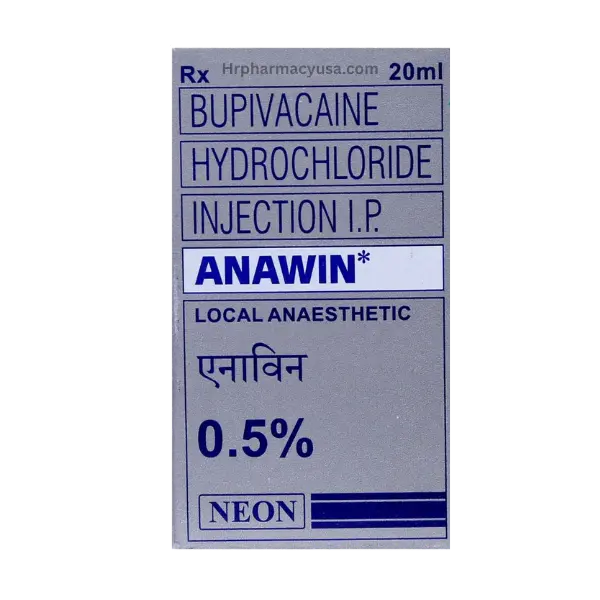
Anawin (Bupivacaine) 0.25 % & 0.5 % Injection – Professional Product Write-Up
Sitting in a dentist’s chair or lying on an operating-room table, nobody wants to feel a thing. That’s where local anaesthetics like Anawin step in. Anawin is the brand name for bupivacaine hydrochloride, a long-acting local anaesthetic widely trusted by surgeons, obstetricians, dentists, and pain-management specialists. Below is a detailed, plain-English breakdown—written the way a seasoned content writer would explain it to clinicians, pharmacists, and informed patients alike.
Quick Product Snapshot
| Item |
Details |
| Brand |
Anawin |
| Generic |
Bupivacaine Hydrochloride |
| Strengths |
0.25 % (2.5 mg/mL) • 0.5 % (5 mg/mL) |
| Dosage Forms |
Single-use glass ampoules & polyampoules; 20 mL multidose vials (preservative-free options available) |
| Administration |
Infiltration, peripheral nerve block, epidural, caudal, intrathecal (with hyperbaric formulation) |
| Manufacturer |
[Insert company name if required by jurisdiction] |
| Pharmacologic Class |
Amide-type local anaesthetic |
What Exactly Is Anawin?
Bupivacaine belongs to the “amide” family of local anaesthetics—the same lineage as lidocaine but with a much longer duration. Because it sticks to sodium channels inside nerve membranes, it prevents the rapid influx of sodium ions that normally generate pain signals. In plain words, the nerves stop firing, so you stop feeling. A single shot can keep a surgical field numb for two to eight hours, depending on concentration, dose, vascularity of the site, and whether a vasoconstrictor such as adrenaline is mixed in.
Why Clinicians Choose Anawin
- Extended Pain Control
• 0.25 % solution: 3–6 hours of surgical anaesthesia, up to 12 hours of post-op analgesia.
• 0.5 % solution: 4–8 hours of surgical anaesthesia, occasionally longer in low-blood-flow tissue.
- Versatility
Works for field infiltration, major nerve blocks (femoral, sciatic, brachial plexus), epidural labour analgesia, spinal anaesthesia (hyperbaric form), and continuous wound catheter infusions.
- Dose-Sparing for Opioids
Effective local control means patients often need fewer systemic opioids—so less nausea, itching, constipation, and respiratory compromise.
- Stable pH and Isotonicity
Formulated for minimal tissue irritation and reduced risk of precipitation when mixed with compatible adjuncts.
Indications at a Glance
| Setting |
Typical Uses |
| Surgery (General & Orthopaedic) |
Intercostal, TAP block, femoral nerve block, infiltration around incision |
| Obstetrics |
Lumbar epidural for labour, caesarean section (with or without opioid adjuvant), pudendal block |
| Dentistry / Maxillofacial |
Mandibular and maxillary nerve blocks when extended numbness is desirable |
| Chronic Pain Clinics |
Stellate ganglion block, facet-joint block, trigger-point infiltration |
| Emergency Medicine |
Large laceration repair, rib fracture analgesia via serratus anterior plane block |
| Spinal Anaesthesia (Hyperbaric) |
Lower-limb orthopaedics, urological procedures, perineal surgery |
Always confirm local regulations and institutional protocols; some jurisdictions restrict certain concentrations for obstetric or intrathecal use.
Dosing & Administration Basics
•
Maximum Recommended Dose (without adrenaline):
– Adults: 2 mg/kg up to 175 mg per single dose; 400 mg per 24 h (cumulative).
– Children > 12 years: 1.5–2 mg/kg (lower in very vascular infiltration).
•
With Adrenaline (1:200,000):
– Up to 225 mg per single dose due to reduced systemic absorption.
•
Epidural Test Dose:
– 3 mL of 0.5 % bupivacaine with 1:200,000 adrenaline to detect intrathecal or intravascular placement. Observe HR changes & sensory level.
•
Spinal (0.5 % Heavy):
– 12–15 mg for lower-limb procedures, 6–10 mg for perineal work. Baricity ensures predictable spread when patient positioning is correct.
Inject slowly, aspirate frequently, and divide the total dose when feasible to limit peak plasma levels.
Onset & Duration Cheat-Sheet
| Concentration |
Onset (min) |
Surgical Analgesia (h) |
Soft-Tissue Analgesia (h) |
| 0.25 % |
10–15 |
2–4 |
4–8 |
| 0.5 % |
5–10 |
4–8 |
8–12 |
(Values vary with site, age, vascularity, and use of vasoconstrictors.)
Safety Profile, Side Effects & Red-Flags
Common, Usually Mild
• Prolonged numbness or tingling
• Local bruising at injection site
• Transient hypotension (epidural/spinal)
Less Common but Serious
- Local Anaesthetic Systemic Toxicity (LAST)
– Symptoms: Metallic taste, circumoral tingling, tinnitus, dizziness → seizures → arrhythmias (ventricular tachycardia, VF).
– Immediate action: Stop injection, secure airway, benzodiazepines for seizure control, 20 % lipid emulsion bolus (1.5 mL/kg) followed by infusion.
- Cardiotoxicity
– Bupivacaine binds avidly to myocardial sodium channels; accidental intravascular injection or overdose can precipitate refractory cardiac arrest.
- Neurotoxicity
– Rare, but potential if high concentration contacts neural tissue for prolonged periods.
- Methemoglobinemia (extremely rare)
– More typical with prilocaine/benzocaine, yet worth watching in neonates or G6PD deficiency.
Contra-indications (Absolute)
• Known hypersensitivity to amide anaesthetics
• Severe AV-block or uncontrolled cardiogenic shock (for regional block requiring large doses)
• Infection at the injection site (for techniques crossing contaminated tissue)
• Coagulopathy for neuraxial techniques unless corrected
Relative Caution
• Pregnancy (category C; widely used epidurally but dosage meticulous)
• Elderly or debilitated (decrease total dose)
• Severe hepatic impairment (slower metabolism)
• Beta-blockers or CYP3A4 inhibitors (slow clearance, watch systemic levels)
Drug & Solution Compatibility
| Compatible Adjuncts |
Notes |
| Adrenaline 1:200,000 |
Prolongs block, decreases bleeding |
| Fentanyl (Epidural) |
Synergistic analgesia, dose-sparing |
| Clonidine |
Extends analgesia, may cause hypotension |
| Dexamethasone (Perineural) |
Controversial but commonly used to extend block |
| Saline 0.9 % |
Dilution for paediatric dosing |
Avoid mixing with strong alkali solutions; precipitation risk.
Storage & Shelf Life
• Store below 25 °C (77 °F); do not freeze.
• Protect from light; keep in original carton until use.
• Single-use ampoules: Discard any unused solution.
• Multidose vials (with preservative): Use within 28 days of first puncture.*
Always follow local policy on open-vial life if stricter.
Handling & Disposal Tips
- Inspect solution: Should be clear, colourless or faint straw. Cloudiness = discard.
- Label syringes immediately; bupivacaine mix-ups with IV drugs are a top sentinel error.
- Use blunt-tip drawing needles to reduce coring of rubber stoppers.
- Dispose of sharps in puncture-proof containers; residual drug in accordance with biohazard rules.
Clinician Talking Points for Patients
• “You’ll notice numbness within about ten minutes.”
• “Avoid chewing on that side until normal feeling returns.”
• “Call me if you feel ringing in your ears, dizziness, or a sudden pounding heart.”
• “You might not feel pain for 6–10 hours, so take your prescribed oral pain medicine before the block completely wears off.”
Frequently Asked Questions (FAQ)
Q1. How long will I stay numb?
A dental block with 0.5 % bupivacaine can keep you comfortably numb for 6–8 hours; larger nerve blocks may last up to 12 hours.
Q2. Is bupivacaine safe in pregnancy?
Yes, it’s routinely used in epidurals for labour. Dosages are carefully titrated and baby’s heart rate is monitored throughout.
Q3. Why not just use lidocaine?
Lidocaine kicks in faster but wears off in 60–120 minutes. If the surgery is long or post-op pain control is important, bupivacaine is the better option.
Q4. Can I drive after receiving a bupivacaine block?
No. Wait until full sensation and muscle power return and your clinician clears you.
Q5. What happens if too much gets into my bloodstream?
Symptoms like metallic taste, ringing ears, or twitching can signal toxicity. Immediate medical treatment—often including IV lipid therapy—reverses it quickly.
Q6. Does it interact with other medicines?
It’s metabolised by liver enzymes. Cimetidine, certain antidepressants, and beta-blockers may slow clearance. Tell your doctor everything you take.
Q7. Does it contain preservatives?
Single-dose ampoules are preservative-free. Multidose vials often contain methylparaben; check the label if you have allergies.
Q8. Can it be used for continuous infusion?
Yes. Low-concentration solutions (0.1 %–0.25 %) are run via epidural pumps for labour or post-op pain. Infusion rates are weight-based.







Reviews
There are no reviews yet.